Tuesday, 26 November 2024

Corporate councils suing Barclays

7 councils in England are suing Barclays over bank loans worth more than £500m they claim they were fraudulently sold.


https://www.publicfinance.co.uk/opinion/2022/03/partner-content-lobo-loans-libor-litigation

The local authorities claim the banking giant manipulated the interest rates on the products, known as lobo loans.
Councils taking the action are
- Leeds
- Greater Manchester
- Newcastle
- North East Lincolnshire
- Nottingham
- Oldham
- Sheffield


Greater Manchester's LOBO loans - another CRIMINAL corporate council!

Manchester City Council is another corporate criminal organisation, using the local registered inhabitants as securities against massive private borrowing.

http://lada.debtresistance.uk/local-authorities/manchester/

Where does all that private borrowing go?
30+% goes to the crooked council's private pension funds.
Another 30+% goes on wages and expenses.
Another 10-15% is paid against the interest on the massive private borrowing
No doubt Manchester inhabitants can think of other ways that the crooked council wastes Public Funds and leaves a minimal amount for Public Services.


Many of the inhabitants of Greater Manchester will be considering ending payments to GMC when they discover how they are being robbed by the same corporation.


Friday, 4 October 2024

A "court order" must physically exist and contain the listed elements

 COURT ORDER

To be a Judicial Document 

Must PHYSICALLY EXIST containing  all the below elements:


1. Court Seal/Stamp: An official court order usually has the seal or stamp of the court, which authenticates the document.


2. Title: The document should start with the name of the court where the order was issued, e.g., "In the High Court of Justice" or "In the County Court at [Location]".


3. Case Number: Each case has a unique identifier or case number, which should be prominently displayed.


4. Parties' Names: The names of the parties involved in the case (e.g., Claimant vs. Defendant).


5. Date: The date when the order was made.


6. Judge's Name and Title:  Yes, the judge's name should typically be on the order, often with their title, like "His Honour Judge [Name]" or "District Judge [Name]" for lower courts, or "Mr/Mrs Justice [Name]" for High Court judges.


7. The Order: The main body of the document will detail the order itself, what has been decided or mandated. This could be in numbered paragraphs.


10. Address: Typically, the court's address where the order was issued might not be on the order itself but on the envelope or cover letter if sent by post. However, if it's included, it would be the address of the court:


11. Court Reference or Claim Number: Essential for filing and reference.


12. Electronic Signature: 

Electronic signature or a statement that the order has been made might appear instead.


With thanks to Beat The Bailiffs

Without a physical court order that has been completed as listed above, the document is fraudulent and the presenter is committing a criminal offence. They should be reported to the police, with all evidence gathered and be prosecuted for their crimes.


Saturday, 28 September 2024

Imprisonment for council tax default is unlawful

An addition to the council tax debate. This is a gem.

https://localgovernmentlawyer.co.uk/litigation-and-enforcement/311-litigation-features/25537-imprisonment-for-council-tax-default#_ftn2

"Imprisonment for council tax default is unlawful because the law states that imprisonment is a last resort and other methods should be tried first: the courts can either order attachment of payment from benefit if the debtor is unemployed or from wages/salary if the debtor has a job, and from any savings account if the debtor has neither job nor benefit but has assets, so there is always an alternative. Unfortunately, some magistrates impose custody on council tax debtors as a punishment; but this is explicitly forbidden by law. Owing money is not a crime, and imposing any form of punishment is not permitted by law. "

Magistrates are not judges and rarely have legal qualifications. They are administrators working for the CPS and are directed by CPS lawyers. Actual justice for all criminal matters means that a Court of Record and jury trial are absolute rights of every individual inhabitant.

Magistrates Courts Act 1980, section 96(1)
There should be no commitment to prison for civil debt except upon complaint, issue of summons and means enquiry in person and finding of wilful refusal/culpable neglect as above.
Note, if you do not appear in court there can be no means enquiry – and therefore no committal!
Six steps for a council tax debtor to be committed to prison:
1. A complaint is filed at the magistrate’s court.
2. A summons is issued and served. Remember a summons is only an invitation.
3. The hearing is attended by the debtor.
4. A means enquiry is conducted with the debtor appearing in person.
5. The court must find ‘wilful refusal’ or ‘culpable neglect’.
6. There must be no other appropriate measure available.
In other words, it is almost impossible to be imprisoned for not paying council tax. It is only meant to serve as a deterrent, not a punishment.

In view of the UN International Covenant of Civil and Political Rights, it would be legally impossible to imprison someone simply for failing to pay a civil debt. Therefore, if imprisonment ever took place, it would in effect be for criminal contempt of court.
But we have two questions: how can you be in criminal contempt of a court in a civil matter? And how can you be in any form of contempt of a court that you do not attend?

https://www.ohchr.org/en/instruments-mechanisms/instruments/international-covenant-civil-and-political-rights
"Article 11
No one shall be imprisoned merely on the ground of inability to fulfil a contractual obligation. "

Wednesday, 25 September 2024

If you want payment, just send an invoice!

If you want payment, just send an invoice!


Council Tax Bills work in the same manner as the mafia, by demands, threats and menaces. Asking for a simple invoice for the local council services provided puts them into a quandary.     

COPY AND PASTE THE LINK BELOW INTO YOUR BROWSER.  

Letters to council PDF:  https://tinyurl.com/ye28cxxz

Have the corporate council provided services as they claim? If they have, they can itemise those services and send an invoice according to the law about demands for payment. There are strict laws regarding contract and payments for services.

Sunday, 15 September 2024

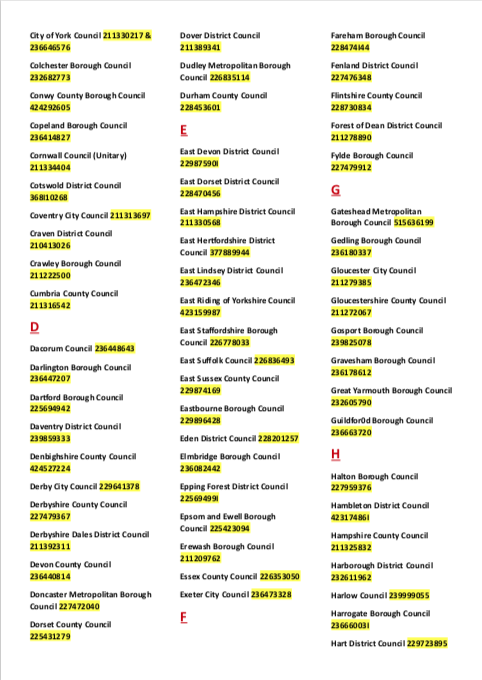
DUNS numbers of 357 councils

All the corporate councils have their own individual DUNS numbers. This means that each council is a registered private company doing business for profit. These private registered corporations have no 'authority' in the Public and no right to hire courts, issue LO or warrants. That makes them criminals guilty of Fraud! Paying criminals is Conspiracy to Pervert the Course of Justice, Aiding and Abetting Crime including Misconduct in Public Office!

Anyone can confirm these facts for themselves. Simply look up the council here:

Here are the DUNS numbers of 357 councils:


There is No Legal Obligation to notify a council of residence for Council Tax

There is No Legal Obligation to notify a council of residence for Council Tax


The case law that you are not under legal obligation to provide the council with your details was affirmed by the Appeal court at point 19 in D, R. v (Rev 1) [2019] EWCA Crim 209 (05 February 2019) 


"There can be no real doubt that on the assumed facts, and assuming that the defendant had herself been resident throughout at this property, as well as being its owner, she would have been legally obliged to pay the due amount of council tax. If she did not, the council could, on demand made under the statutory scheme, seek recovery of the sums due in the civil courts. But that cannot of itself, as we see it, connote that she was obliged in law to notify the council of her continued residence. It is quite wrong to equate a liability to pay with a liability to notify. It may be, as the judge thought, that one might have expected to find such a provision as to notification in the statutory scheme. But that was a matter for Parliament to decide. The fact is, as we have said, that such a provision simply is not there, either within the primary legislation or in subordinate legislation made pursuant to the provisions of the 1992 Act itself."